How to Promote a Lead Magnet Without Sounding Pushy

Creating a lead magnet is a smart way to grow your email list, attract the right people, and offer helpful value before someone becomes a customer.
But once the free resource is finished, many people run into the same problem:
They do not know how to promote it.
They may have a useful checklist, guide, report, worksheet, or template ready to share, but when it is time to post about it, the wording feels awkward.
They do not want to sound pushy.
They do not want to keep saying, “Download my free guide.”
They do not want every post to feel like an ad.
That is where soft-promotion content can help.
Soft promotion lets you talk about your lead magnet in a natural, helpful way. Instead of forcing the freebie into every post, you connect the resource to a real problem, useful tip, common mistake, or simple invitation.
This makes your lead magnet easier to share and easier for your audience to respond to.
Why Lead Magnet Promotion Feels Hard
A lot of business owners, coaches, creators, and service providers are comfortable creating helpful resources.
They can make the checklist.
They can write the guide.
They can build the template.
But promoting it repeatedly feels different.
The most common concern is sounding too salesy. Even though the resource is free, people still worry that repeated promotion will annoy their audience.
The second issue is repetition. Many people only know one way to promote a freebie:
“Grab my free guide here.”
That can work once, but it gets old quickly.
The third issue is lack of angles. If you do not know how to connect your free resource to different everyday problems or useful ideas, it becomes difficult to create fresh posts.
The good news is that you do not need a complicated strategy to fix this. You need better starting points.
What Is Soft Promotion?
Soft promotion is a way of sharing an offer without making the post feel overly promotional.
For a lead magnet, that means the post may start with:
- A problem your audience recognizes
- A quick tip
- A common mistake
- A relatable situation
- A simple checklist
- A personal reason you created the resource
- A gentle invitation to get the free download
The lead magnet is still mentioned, but it is introduced in a helpful context.
Instead of saying:
“Download my free guide now.”
You might say:
“If you are trying to plan your content but keep getting stuck at the blank page, I put together a free checklist that walks through the first few steps. Comment CHECKLIST and I will send it over.”
That feels more natural because it starts with the audience’s problem.
Who Needs Lead Magnet Promotion Posts?
Soft-promotion posts are useful for anyone who gives away a free resource as part of their marketing.
This includes:
Coaches with free checklists, consultants with free guides, creators with templates, newsletter owners with opt-ins, course sellers with worksheets, and service providers with helpful PDF downloads.
It is especially useful for people who know their free resource is valuable but struggle to share it consistently.
If your lead magnet only gets mentioned once, many people in your audience may never see it. Posting about it in different ways gives more people a chance to notice it, understand why it matters, and decide whether they want it.
What Should You Include in a Lead Magnet Promo Post?
A strong lead magnet promotion post does not need to be complicated.
Most effective posts include five simple parts:
1. A Clear Hook
Start with something your audience recognizes.
Examples:
“Struggling to promote your free guide without sounding pushy?”
“Your checklist will not help people if they never see it.”
“Made a lead magnet but not sure what to post about it?”
2. A Problem or Desire
Show that you understand what the audience is trying to solve.
This could be a frustration, goal, mistake, or common situation.
3. A Helpful Insight
Give the post value before asking for action.
This might be a tip, reminder, short list, or useful perspective.
4. A Natural Mention of the Free Resource
Introduce the lead magnet as a helpful next step.
For example:
“I made a free checklist to help with this.”
5. A Gentle CTA
End with a simple invitation.
Examples:
“Comment GUIDE and I will send it over.”
“Click here to grab the free checklist.”
“Message me FREEBIE if you want a copy.”
The CTA should be clear, but it does not need to be aggressive.
10 Post Angles You Can Use to Promote a Lead Magnet
Here are 10 simple angles you can use to promote the same free resource without repeating yourself.
1. Problem-Aware Post
Talk about the problem your freebie helps solve.
Example:
“If planning your weekly content always turns into a last-minute scramble, I made a free checklist that can help you organize your ideas faster.”
2. Helpful Tip Post
Share one useful tip related to the lead magnet topic, then invite people to get the full resource.
3. “I Made This Because…” Post
Explain why you created the free resource and who it is meant to help.
4. Quick Checklist Post
Give a short list of steps or reminders, then mention that the full checklist is available.
5. Relatable Struggle Post
Start with a real situation your audience has likely experienced.
6. Common Mistake Post
Point out a mistake and offer the freebie as a helpful way to avoid it.
7. Beginner-Friendly Post
Position the resource as a simple starting point for people who feel overwhelmed.
8. Time-Saving Post
Explain how the resource can help someone avoid starting from scratch.
9. Curiosity-Based Post
Open a loop that makes people want the resource.
10. Direct but Warm Invitation
Clearly offer the freebie, but in a friendly and low-pressure way.
These angles can turn one lead magnet into many different posts.
Example: Turning One Lead Magnet Into Multiple Posts
Lead magnet title:
The Small Business Website Checklist
A pushy post might say:
“Download my free website checklist now.”
A softer version could say:
“Before you send people to your website, it helps to make sure the basics are covered. Clear headline, simple navigation, easy contact option, and one obvious next step can make a big difference. I put together a free Small Business Website Checklist if you want a simple way to review yours.”
Another angle could be:
“A lot of small business websites are not broken. They are just unclear. If visitors cannot quickly understand what you offer, who you help, and what to do next, they may leave before taking action. I made a free checklist to help you review the key pieces.”
Same lead magnet. Different angle. Less repetition.
How Lead Magnet Post Generator Helps
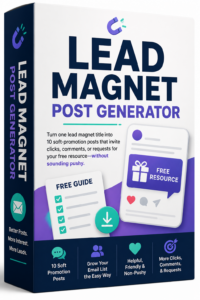
Lead Magnet Post Generator is a Custom GPT designed to make this process faster.
Instead of starting from a blank page, you paste in your lead magnet title and get back 10 soft-promotion social posts.
It can help you create posts for free reports, checklists, guides, templates, worksheets, swipe files, resource lists, and other free downloads.
The GPT creates different post angles so you are not saying the same thing over and over. It also includes gentle CTA options you can use for comments, direct messages, or links.
What You Paste In
At minimum, you can paste in the lead magnet title.
Example:
The 5-Step Client Onboarding Checklist
For better results, you can also include:
- Audience
- Platform
- Tone
- CTA style
- Business type
- Problem the freebie solves
Example:
Lead magnet title: The 5-Step Client Onboarding Checklist
Audience: freelance designers
Platform: LinkedIn
CTA: Ask people to comment CHECKLIST
Tone: helpful and professional
What You Get Back
Lead Magnet Post Generator gives you:
- A short positioning summary
- 10 soft-promotion posts
- A CTA bank with optional call-to-action lines
The output is designed to be copy-ready, but still easy to edit.
You can use the posts as-is, add your link, adjust the tone, or ask the GPT to rewrite them for a specific platform.
Use Cases
You can use the posts for:
- Facebook content
- LinkedIn posts
- Instagram captions
- Newsletter teaser sections
- Community posts
- Content calendars
- Launch week freebie promotion
- Ongoing list-building content
You can also create a new batch whenever you want a fresh set of angles.
FAQ
How often should I promote my lead magnet?
There is no single rule, but one mention is usually not enough. People miss posts, join your audience at different times, or need to see a resource more than once before taking action. Using different angles helps promotion feel less repetitive.
Can I use the same lead magnet post on different platforms?
Yes, but it helps to adjust the tone and length. A LinkedIn post may be more professional. An Instagram caption may need more spacing and a stronger hook. A Facebook post can be warmer and more conversational.
What if I only have the title?
That is enough to start. Lead Magnet Post Generator can infer a useful direction from the title and create a first draft. You can always refine the posts afterward.
What makes a lead magnet post sound pushy?
Pushy posts often focus only on the download instead of the audience’s problem. A softer post starts with value, context, or relatability before inviting someone to get the resource.
Can this work for comment-to-request posts?
Yes. You can ask for CTAs like “Comment GUIDE,” “Comment CHECKLIST,” or “DM me FREEBIE.” You can also ask for link-based CTAs.
Final Thoughts
A lead magnet is only useful if people know it exists.
But promoting it does not have to feel uncomfortable.
With soft-promotion posts, you can share your free resource in a way that feels helpful, natural, and easy for your audience to respond to.
Start with the problem your audience cares about. Add a useful tip or relatable angle. Then invite them to get the free resource.
And if you want a faster way to create those posts, Lead Magnet Post Generator turns one lead magnet title into 10 soft-promotion posts you can customize and share.
Use Lead Magnet Post Generator to create friendly, non-pushy posts for your next free guide, checklist, report, or template.
Click Here For Access
Related Posts




Hi! I'm Larry.
I’ve been around online marketing for a long time — since the late 1990s — and I’ve seen the good, the bad, and a lot of the hype.
As someone who’s 83 years old and still doing online business, I understand the challenges that come with trying to get something profitable going later in life.
That’s why I want you to know exactly what I stand for.
These are the core beliefs that guide everything I teach, recommend, and create:
-
Tools don’t build businesses — people do. That’s why I'm here to provide step-by-step help with everything I recommend.
-
Every dollar matters. If I wouldn’t spend my own money on it, I won’t ask you to.
-
No magic bullets. You’ll succeed by learning and sticking with it — not by chasing shortcuts.
-
You’re not too old to win. If I can do it at 83, so can you.
-
Structure beats overwhelm. I break things down so you always know your next step.
-
Personal help matters. You’ll never be just a number with me.
-
This is about freedom. More than money, I want to help you enjoy the lifestyle you deserve.